

Tag: Gold Purity Testing

  • Sell Gold From Home: What Happens During a Doorstep Visit?

    Sell Gold From Home: What Happens During a Doorstep Visit?

    Selling old gold jewellery does not always mean visiting a gold buyer’s shop. Have old gold bangles, chains, or rings at home? G1 Gold makes it easy to sell your gold from home with its doorstep gold-buying service.

    But how does it work? Will your jewellery be tested at home? How is the price calculated? And when will you receive payment?

    If you are planning to sell gold from home, understanding the process can help you make an informed decision.

    What Does Selling Gold From Home Mean?

    Selling gold from home allows you to arrange a jewellery valuation without travelling to a gold buying branch.

    This option is helpful for people with busy schedules, unused jewellery, or difficulty visiting a shop.

    Before booking, understand how your gold will be tested, weighed, and valued.

    1. Book a Doorstep Gold Valuation Visit

    Start by contacting G1 Gold to enquire about doorstep gold buying services in your area.

    Share your location and the type of gold jewellery you want to sell.

    Before booking, ask:

    • Is doorstep gold buying available at my location?
    • Will purity testing happen at home?
    • Are there any visiting or testing charges?
    • What documents are required?
    • Can I reject the offer after valuation?

    These questions help you understand the process and prepare for the doorstep visit.

    2. Keep Your Gold Jewellery Ready

    Collect the jewellery you want evaluated before the representative arrives.

    You may have broken chains, old necklaces, unused bangles, or earrings that you no longer wear.

    Things to prepare:

    • Separate gold jewellery from imitation ornaments.
    • Keep purchase bills if available.
    • Identify jewellery containing stones or beads.
    • Keep a valid identity document ready.
    • Choose which items you want evaluated.

    You can review the offered price before deciding whether to sell.

    3. How Is Gold Purity Checked at Home?

    Gold purity plays an important role in determining your jewellery’s selling price.

    For example, 22K gold contains more pure gold than 18K gold, so their values differ.

    Some gold buyers use XRF technology to assess metal composition without cutting or melting the jewellery. However, testing equipment may vary during doorstep visits.

    Ask the representative:

    • What is the purity of my gold?
    • Does it match the hallmark?
    • Will testing affect my jewellery?
    • How does purity influence the price?

    Understanding the test results helps you know how your gold is valued.

    4. How Is Gold Weight Measured?

    After purity testing, the jewellery is weighed to calculate its value.

    Some ornaments contain stones, beads, or other materials that are not gold.

    For example, a necklace weighing 25 grams may contain less than 25 grams of gold.

    During weighing:

    • Check that the digital scale starts at zero.
    • Observe the displayed weight.
    • Ask whether stone weight is excluded.
    • Confirm the weight used for valuation.
    • Request separate weights for multiple items.

    Knowing the applicable gold weight helps you understand the price calculation.

    5. How Is Your Gold Selling Price Calculated?

    The buyer calculates the offered price using several factors.

    • Gold Purity: The actual gold content in your jewellery.
    • Gold Weight: The applicable weight used for valuation.
    • Current Gold Rate: The buying rate applied during evaluation.
    • Deductions: Any applicable charges or adjustments.

    For example, an 18K ring and a 22K ring of equal weight usually have different selling values.

    Ask for a clear price breakdown before accepting the offer.

    Remember that jewellery making charges are generally not recovered when selling old gold.

    6. Review the Offer Before Selling

    After evaluation, the buyer explains the amount offered for your jewellery.

    Take time to check the details.

    Before accepting, confirm:

    • The recorded gold purity and weight.
    • The gold rate used.
    • Any applicable deductions.
    • The final amount offered.
    • Available payment options.

    If the offer does not meet your expectations, you can choose not to sell. Confirm any applicable visit charges beforehand.

    7. How Does Payment Work?

    Once you accept the offer, the buyer explains the payment process.

    Payment methods and timelines may differ depending on the company.

    Before handing over your gold, ask:

    • Which payment methods are available?
    • When will I receive payment?
    • Is identity verification required?
    • Will I receive a transaction receipt?

    Always confirm the agreed amount and payment terms before completing the sale.

    Why Consider G1 Gold for Doorstep Gold Selling in Bangalore?

    If you want to sell gold from home in Bangalore, G1 Gold offers an option to enquire about doorstep gold-buying services.

    Customers can ask about purity testing, gold weighing, valuation methods, and the applicable buying rate.

    Before booking a visit, check if doorstep service is available in your area. Also, ask how your gold will be checked and how you will receive payment.­

    Important Things to Check Before Selling Gold From Home

    Before booking a doorstep visit, follow these precautions:

    • Verify the buyer: Check the company’s business details.
    • Understand testing: Ask how gold purity will be checked.
    • Check the weight: Observe the weighing process.
    • Review the rate: Understand which gold rate applies.
    • Ask about deductions: Confirm any charges.
    • Verify payment: Understand the payment process before handing over jewellery.

    These checks can help you make an informed selling decision.

    Frequently Asked Questions

    1. Can I sell gold from home without visiting a shop?

    Yes. Some gold buyers offer doorstep services that allow you to arrange a gold valuation at home. Availability depends on your location.

    2. Can I sell broken gold chains and old bangles from home?

    Yes. Many gold buyers accept broken chains, unused bangles, rings, and other old jewellery. The price depends on purity, applicable weight, and the buying rate.

    3. How is gold purity tested during a doorstep visit?

    Some buyers use XRF testing to assess gold purity. However, testing methods and equipment may vary. Confirm the process before booking.

    4. Do I need a purchase bill to sell gold from home?

    A purchase bill can be helpful but may not always be required. Buyers generally ask for valid identity documents.

    5. Can I reject the price after gold valuation?

    Yes. You can review the offered price before deciding to sell. Confirm any evaluation or visiting charges in advance.

    Conclusion

    Choosing to sell gold from home can save you a trip to a gold buying branch.

    Before selling your gold, check its purity, weight, and current buying rate. Also, understand how you will receive payment.

    If you have a broken chain, an old necklace, or unused bangles, check the gold price offered before selling.

    Contact G1 Gold to enquire about doorstep gold selling services in Bangalore.
     

  • What to Check on Your Gold Valuation Slip Before Accepting Payment

    What to Check on Your Gold Valuation Slip Before Accepting Payment

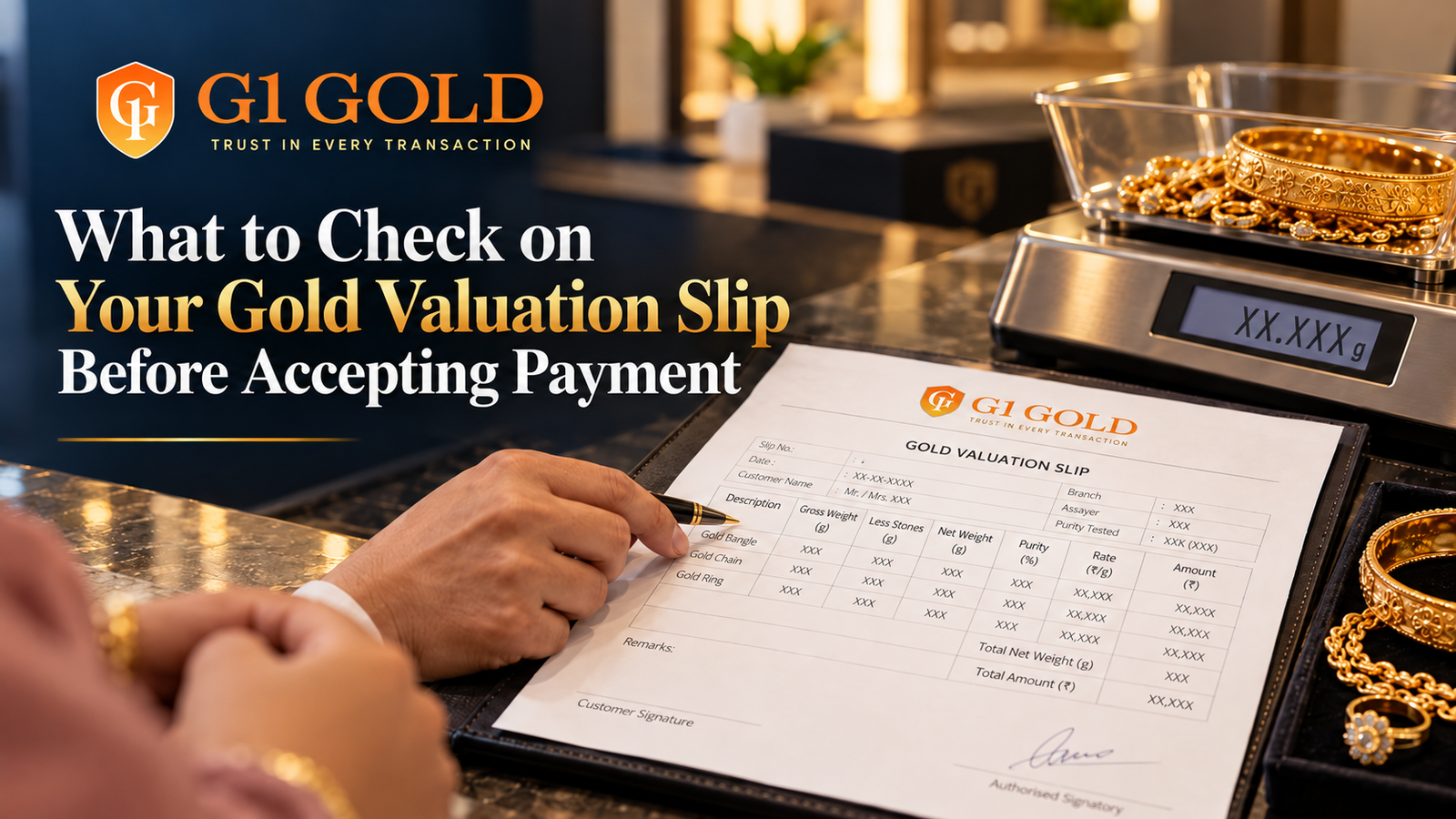
    When you visit a gold buying branch to sell your old jewellery, the buyer checks its purity and weight before preparing a Gold Valuation Slip. But how can you tell if the amount shown on the slip is calculated correctly?

    A gold valuation slip shows how the buyer determines the value of your jewellery. It helps you understand the gold weight, purity, current rate, and final payment amount.

    Before you sell gold in Bangalore, take a moment to review these details. Knowing what each figure means can help you avoid confusion and make a better decision.

    Here are the key things to check on your gold valuation slip before accepting payment.

    1. Understand the Difference Between Gross Weight and Net Gold Weight

    Net gold weight is an important detail to check on your gold valuation slip.

    Gross weight includes the entire ornament, while net gold-alloy weight excludes stones, beads, and other non-gold materials.

    For example, if your necklace weighs 25 grams but contains 3 grams of stones and other materials, the remaining weight is 22 grams.

    Valuation Detail Weight
    Gross Jewellery Weight 25 grams
    Non-Gold Material Weight 3 grams
    Net Gold-Alloy Weight 22 grams

    In this example, only 22 grams are considered for gold valuation before checking the purity.

    The final gold value also depends on how pure the gold is.

    Before accepting the valuation, ask the buyer:

    • How was the net gold weight calculated?
    • Were stones and other materials excluded?
    • Does the net weight match the amount shown on the slip?

    Checking these details helps you understand how the buyer calculated your jewellery’s value.

    2. Check the Gold Purity Mentioned on the Slip

    Gold jewellery comes in different purity levels. Some ornaments are made from 22-karat gold, while others contain 18-karat or lower-purity gold.

    The purity of your jewellery affects its selling value. Therefore, gold buyers in Bangalore check the gold purity before calculating the final amount.

    Before accepting your gold valuation slip, check these details:

    • Is the tested gold purity clearly mentioned?
    • Were different ornaments tested separately?
    • Does the purity shown on the slip match the test results?
    • Did the buyer explain any difference between the hallmark and tested purity?

    For example:

    • 22K gold: Contains approximately 91.67% pure gold.
    • 18K gold: Contains 75% pure gold.

    Higher gold purity generally means a higher value per gram when other factors are the same.

    Always check the purity results and ask for an explanation if anything is unclear before accepting the final valuation.

    3. Check the Gold Rate Used for Valuation

    Gold rates change daily based on market conditions. So, it is important to check the rate used to calculate your jewellery’s value.

    Your gold valuation slip should clearly show the gold rate applied during the valuation.

    Before accepting the final amount, check these details:

    • What is today’s gold rate?
    • Is the rate based on 24K, 22K, or another gold purity?
    • Does the buyer use the tested gold purity to calculate the value?
    • Is the gold rate per gram clearly mentioned on the slip?

    The market gold rate and the buying rate offered by a gold buyer may be different.

    For example, the displayed market rate may not be the exact rate used to purchase your jewellery.

    Always confirm which gold rate is applied and how it affects your final payment. This helps you understand the offered amount before selling your gold.

    4. Check for Deductions Before Accepting the Final Amount

    The final payment may be different from the calculated gold value if the buyer applies any deductions.

    For example, your jewellery may be valued at ₹85,000, but the buyer offers ₹82,500. Before accepting, ask why ₹2,500 was deducted.

    Check your gold valuation slip for the following details:

    • Are there any gold testing or processing charges?
    • Were deductions made for stones or other non-gold materials?
    • Are there any additional service charges?
    • Has the buyer explained every deduction from the calculated value?

    Not every gold buyer follows the same deduction policy. So, make sure you understand each charge before agreeing to sell your jewellery.

    At G1 Gold Company, customers can ask about gold purity, weight, applied gold rates, and the final payment amount before approving the sale.

    5. Check the Calculated Gold Value and Final Payment

    After checking the gold purity, weight, and gold rate, make sure the final payment matches the calculated value.

    Your gold valuation slip should clearly show how the buyer calculated the amount offered for your jewellery.

    For example:

    Valuation Detail Example
    Net Gold Weight 20 grams
    Gold Purity 22K (91.67%)
    Example 24K Gold Rate ₹12,000 per gram
    Calculated Gold Value ₹2,20,008
    Example Deduction ₹2,000
    Final Payment Amount ₹2,18,008

    Note: These amounts are only examples and do not represent today’s gold rates. The calculation uses a rounded purity of 91.67%.

    Before accepting payment, check these details:

    • Does the calculated value match the gold weight, purity, and rate?
    • Are all deductions clearly mentioned?
    • Does the final amount match the buyer’s offer?
    • Has the buyer explained how the final payment was calculated?

    If the slip shows only the final amount, ask for a detailed breakdown.

    Checking the calculation helps you understand your jewellery’s value before accepting payment.

    6. Keep a Copy of Your Gold Valuation and Payment Records

    After selling your gold, keep a copy of your gold valuation slip and payment receipt.

    These documents help you check the transaction details if needed in the future.

    Make sure your records include:

    • The date you sold your gold.
    • Details of the jewellery you sold.
    • The final agreed payment amount.
    • Payment confirmation or transaction reference number.

    Keep these documents in a safe place for future reference.

    Having a copy of your records helps you confirm what you sold and how much you received.

    Conclusion

    Selling old gold jewellery is easier when you know how its value is calculated.

    A gold valuation slip shows the gold weight, purity, current rate, deductions, and final payment amount. Checking these details helps you understand the price offered for your jewellery.

    Whether you are selling unused jewellery or gold released from a loan, check its value before accepting payment.

    G1 Gold Company checks your jewellery’s purity and weight. The team also explains how the final gold value is calculated.

    Always check the final amount and ask questions if anything is unclear before completing your gold sale.

    Frequently Asked Questions

    1. What is a gold valuation slip?

    A gold valuation slip shows how a buyer calculates your jewellery’s value. It may include gold weight, purity, current gold rate, deductions, and final payment amount.

    2. Why is net gold weight different from gross weight?

    Gross weight includes the entire ornament, including stones and other materials. Net gold-alloy weight excludes these non-gold materials. The buyer then checks the gold purity to calculate its value.

    3. Can I ask the buyer to explain the gold valuation?

    Yes. You can ask the buyer to explain the gold purity, weight, applied gold rate, and any deductions before accepting the final offer.

    4. Does a gold valuation slip confirm the final payment?

    Not always. The final payment may depend on completing the gold verification and approval process. Confirm the agreed amount before handing over your jewellery.

    5. Should I keep my gold valuation slip after selling my jewellery?

    Yes. Keep your gold valuation slip, sales receipt, and payment confirmation. These documents help you check your transaction details whenever needed.