

Category: Blog

Your blog category

  • Puneeth Rajkumar 5th Death Anniversary 2026: Remembering Karnataka’s Beloved Appu

    Puneeth Rajkumar 5th Death Anniversary 2026: Remembering Karnataka’s Beloved Appu

    October 29 is an emotional day for Kannada cinema lovers across Karnataka as we remember Dr. Puneeth Rajkumar, lovingly known as Appu, on his fifth death anniversary. Even after five years since his passing on October 29, 2021, at the age of 46, his unforgettable smile, remarkable acting, and kindness continue to live in the hearts of millions.

    His untimely demise was a great loss to the Kannada film industry. However, his films, social work, and inspiring personality continue to keep his legacy alive. At G1 Gold, Malleshwaram, Bengaluru, we join people across Karnataka in remembering our beloved Appu with love, respect, and gratitude.

    Who Was Puneeth Rajkumar?

    Puneeth Rajkumar was one of the most loved actors in Kannada cinema. He was born on March 17, 1975, to legendary actor Dr. Rajkumar and Parvathamma Rajkumar. He started his career as a child artist. His performance in Bettada Hoovu earned him the National Film Award for Best Child Artist.

    Later, he became a successful lead actor. Fans lovingly called him Appu, a name that became closely associated with his identity. Besides acting, Puneeth was also a talented singer and television presenter. His friendly nature and humble personality helped him connect with people from all walks of life.

    Puneeth Rajkumar’s Contribution to Kannada Cinema

    Puneeth Rajkumar made his debut as a lead actor in the 2002 film Appu. The movie became a major milestone in his career. Over the years, he acted in many popular Kannada films, including Milana, Jackie, Hudugaru, Raajakumara and Yuvarathnaa.

    His movies offered a mix of action, comedy, romance and family entertainment. They also highlighted values such as friendship, courage and family relationships. In addition to films, Puneeth connected with television audiences through programmes such as Kannadada Kotyadhipati. His natural presentation style made the show popular among viewers.

    Even today, fans enjoy watching his movies and listening to his songs. For many families, his films bring back wonderful memories.

    Why Do Millions of Fans Remember Appu?

    Puneeth Rajkumar was admired for more than his acting skills. His kindness, humility and warm smile made him special to his fans. Despite his popularity, he maintained a friendly and approachable personality. This helped him build a strong bond with people across Karnataka.

    Moreover, his films celebrated Kannada language and culture. Through his work, he contributed to the growth and popularity of Kannada cinema. His charitable activities also earned him great respect. Many people remember him for his generosity and concern for others.

    These qualities explain why fans continue to remember him with love. His life reminds us that kindness and compassion can make a lasting difference.

    Puneeth Rajkumar’s Philanthropy and Social Work

    Puneeth Rajkumar was loved and respected for his charity work and support for social causes. He helped people through education, healthcare, and support for those in need. His kindness and care for others earned him great respect.

    For many fans, his achievements went beyond the film industry. They also remember his generosity and his efforts to help others. His life continues to inspire people to support their communities and lend a helping hand to those in need.

    Remembering Appu reminds us to be kind, respect others, and help people in need.

    October 29: Remembering Five Years Without Appu

    The news of Puneeth Rajkumar’s passing on October 29, 2021, shocked the Kannada film industry and his millions of fans. People across Karnataka expressed their grief and paid tribute to the beloved actor. His absence left a deep void in the hearts of those who admired him.

    Five years later, fans continue to honour his memory through tributes, film screenings and messages on social media. His films also continue to reach new audiences. Young people can learn about his talent and understand his important role in Kannada cinema.

    This fifth death anniversary reminds us that a person’s memories and influence can live on for generations. Puneeth Rajkumar will always be remembered as a talented actor who touched countless hearts.

    Five Years Later, Appu Lives on in Our Hearts

    Even five years after his passing, Puneeth Rajkumar continues to hold a special place in the hearts of people across Karnataka. His films continue to entertain audiences. His songs bring back happy memories, and his life continues to inspire people.

    For longtime fans, his movies are a reminder of the wonderful moments they shared with family and friends. Meanwhile, younger viewers continue to discover his work. Remembering Appu is not just about marking the anniversary of his passing. It is also about celebrating the happiness he brought to others.

    His life teaches us to value our loved ones, help people in need and treat everyone with kindness. The love he continues to receive shows the lasting bond between a beloved actor and his audience.

    G1 Gold, Malleshwaram, Pays Tribute to Puneeth Rajkumar

    On this fifth death anniversary, G1 Gold joins people across Karnataka in paying tribute to Dr. Puneeth Rajkumar. G1 Gold is a gold buying company in Malleshwaram, Bengaluru. We value customer trust and honesty. We believe in clear communication and treating every customer with care and respect.

    If you are planning to sell old, unused or broken gold jewellery, you can contact G1 Gold to learn about the gold evaluation process. Our team explains how we test your gold’s purity, check its weight, calculate its value, and make payments.

    Visit our website: https://g1gold.com/

    G1 Gold is located in Malleshwaram, Bengaluru. We help customers who want to sell their gold jewellery. Today, we join the people of Karnataka to remember our beloved Appu and honour his contribution to Kannada cinema.

    We extend our heartfelt respect to his family, friends, colleagues and fans who continue to cherish his memory. Puneeth Rajkumar’s legacy will remain an important part of Karnataka’s cultural history.

    Forever remembered. Forever loved. Appu lives on in our hearts.

    This article is an independent tribute to Dr. Puneeth Rajkumar. G1 Gold is not affiliated with or endorsed by Puneeth Rajkumar or his family.
     

  • Why Does Your Gold Jewellery’s Weight Change During Valuation?

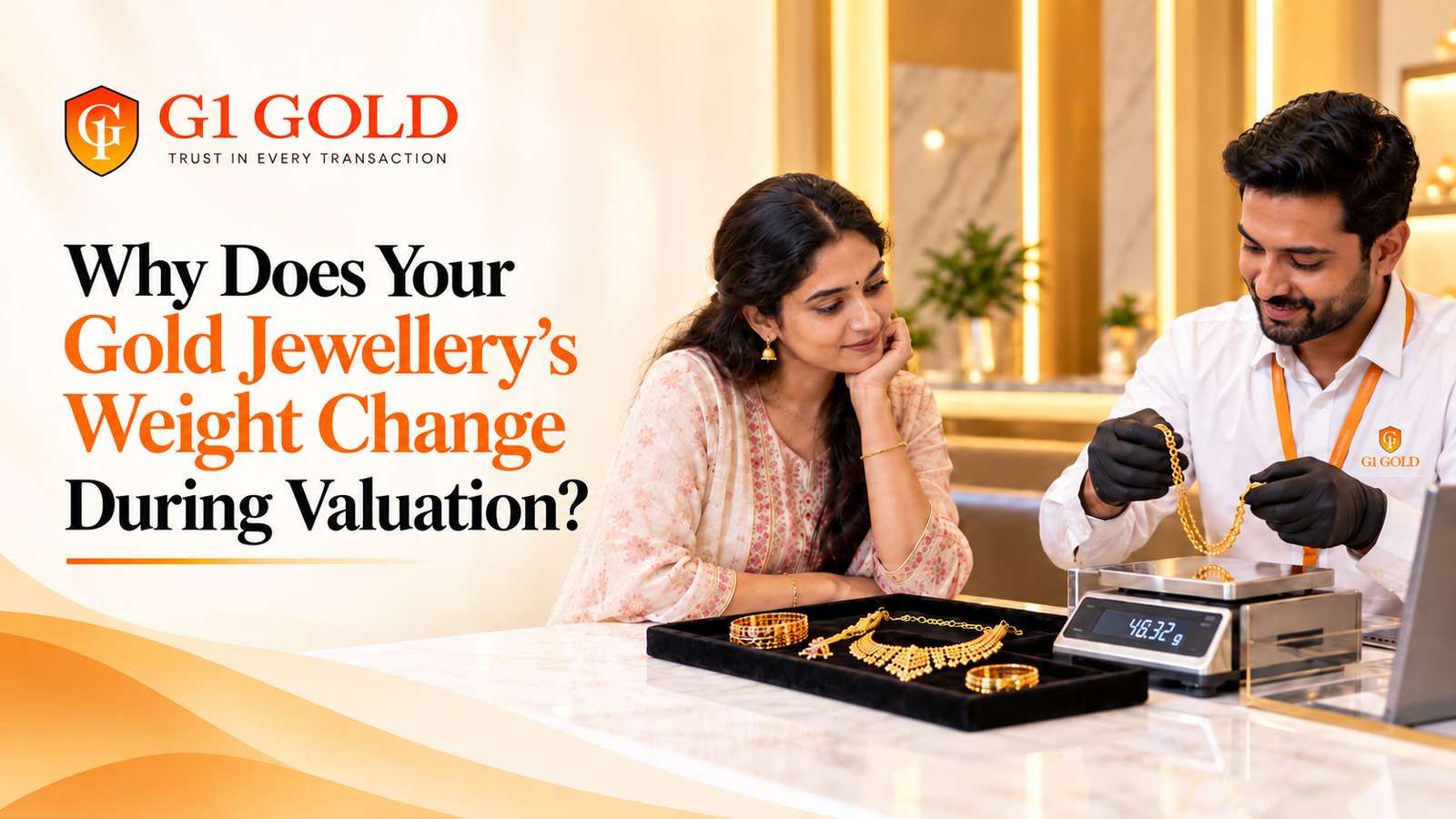
    Why Does Your Gold Jewellery’s Weight Change During Valuation?

    Gold jewellery often holds special memories. It may be a wedding gift, something bought with your savings, or passed down through your family. When you decide to sell it, you expect the price to depend on the gold jewellery weight and the current gold rate.

    But what if your necklace weighs 20 grams and the buyer calculates its value using only 18 grams? This can be confusing, especially if you are selling gold for the first time. The reason is simple. Your jewellery may contain stones, beads, or other materials that are not gold. Understanding how gold valuation works can help you know its value and make a better decision.

    1. What Is Gross Weight and Net Gold Weight in Jewellery?

    During gold valuation, you may hear two terms: gross weight and net gold weight.

    Gross weight is the total weight of your jewellery, including gold, stones, and other materials.

    Net gold weight is the weight of the gold alloy after excluding non-gold materials.

    For example, consider a gold necklace weighing 20 grams.

    • Total necklace weight: 20 grams
    • Stones and other materials: 2 grams
    • Net gold alloy weight: 18 grams

    The buyer may calculate its value using 18 grams instead of 20 grams.

    Your jewellery has not lost weight. The buyer is simply calculating the gold alloy weight separately.

    2. Why Do Gold Buyers Deduct the Weight of Stones?

    Many gold ornaments contain materials other than gold.

    A ring may have a gemstone, while a necklace may contain colourful stones or decorative beads.

    These materials add weight but are not part of the gold.

    Gold buyers may exclude:

    • Gemstones and artificial stones
    • Decorative beads
    • Enamel and non-gold materials
    • Threads and attachments
    • Other non-gold decorative parts

    For example, an 8-gram ring with a 1-gram stone may contain approximately 7 grams of gold alloy.

    Understanding these deductions helps explain why the net gold weight may be lower than the total weight.

    3. Does Gold Purity Affect Your Jewellery’s Weight?

    Gold purity affects the amount of pure gold in your jewellery, but it does not change its physical weight.

    Most gold jewellery contains other metals to make it stronger.

    Common purity levels include:

    • 24K: Approximately 99.9% pure gold
    • 22K: Approximately 91.6% pure gold
    • 18K: 75% pure gold
    • 14K: Approximately 58.5% pure gold

    For example, 10 grams of 22K gold alloy contains approximately 9.16 grams of pure gold.

    The ornament still weighs 10 grams. Its purity tells you how much of that weight is gold.

    Both weight and purity matter when you sell gold in Bangalore.

    4. Can Jewellery Design Affect Gold Weight?

    Yes. Jewellery design can affect the amount of gold present.

    A plain chain and a stone-studded necklace may both weigh 25 grams. However, the necklace may contain less gold because of its stones and decorative materials.

    Some jewellery may contain:

    • Wax or lac filling
    • Hollow sections
    • Non-gold supporting materials
    • Decorative fittings

    These materials may not be visible from the outside.

    A proper valuation helps identify the estimated gold alloy weight.

    5. How Does German XRF Technology Check Gold Purity?

    Gold purity testing is an important part of jewellery valuation.

    At G1 Gold Company, we use German XRF Technology for Gold Purity Testing to check the purity of gold jewellery.

    XRF stands for X-ray Fluorescence. It uses X-rays to analyse the metal composition near the jewellery’s surface.

    Benefits of XRF testing include:

    • Non-destructive testing: Normally does not require cutting or melting jewellery.
    • Quick results: Checks the metal composition within a short time.
    • Purity information: Helps identify the gold content in the tested area.
    • Clear results: Helps customers understand their jewellery’s purity.

    XRF testing measures the surface composition. Gold plating, solder, or different metals in your jewellery can affect the test results. Sometimes, more tests may be needed to check the purity accurately.

    6. How Do Gold Buyers Calculate Your Jewellery’s Selling Price?

    Gold buyers generally calculate the price using:

    • Net gold alloy weight
    • Gold purity
    • Applicable gold buying rate
    • Any disclosed charges or deductions

    For example:

    Suppose your jewellery has:

    • Net gold alloy weight: 15 grams
    • Purity: 22K
    • Example 22K buying rate: ₹12,000 per gram

    Estimated value = 15 × ₹12,000 = ₹1,80,000

    This is only an example, not a current gold rate or confirmed buying offer.

    The final amount may vary depending on testing results and the buyer’s pricing terms.

    Always ask how the final price is calculated.

    7. What Should You Check Before Selling Your Gold?

    Before selling your jewellery, take a few minutes to understand the valuation.

    Follow these simple steps:

    1. Check the weight: Ask to see your jewellery being weighed.
    2. Understand deductions: Check whether stones or other materials affect the weight.
    3. Check purity: Ask how your gold’s purity is tested.
    4. Know the rate: Confirm the gold buying rate.
    5. Review the offer: Understand the final price and any charges.

    At G1 Gold Company, we show you how your gold is checked and weighed. We also explain the price clearly before you decide to sell.

    Knowing these details can help you make an informed decision.

    Frequently Asked Questions

    1. Why does my gold jewellery weigh less during valuation?

    Your jewellery may contain stones, beads, or other materials. Buyers may exclude these when calculating the net gold weight.

    2. Does removing stones reduce my gold’s value?

    Removing stones does not reduce the amount of gold present. It helps determine the gold alloy weight. Stones may have a separate value.

    3. Is German XRF Technology safe for gold jewellery?

    Yes. XRF testing checks your gold’s purity without normally cutting, melting, or damaging your jewellery.

    4. Does 22K gold contain less pure gold than 24K gold?

    Yes. 22K gold contains about 91.6% pure gold, while 24K gold contains about 99.9% pure gold.

    5. Where can I check my gold jewellery’s purity in Bangalore?

    Choose a trusted gold buyer who checks your gold’s purity and clearly explains its value. Always check the weight, purity, and price before selling.

    Conclusion

    Your jewellery does not actually lose weight during valuation. The difference comes from removing the weight of stones, beads, and other materials that are not gold. Gold purity also affects the final selling price.

    Before selling, check your jewellery’s net gold weight, purity, and value. If you want to sell gold in Bangalore, G1 Gold Company uses German XRF Technology to test gold purity and clearly explain how the price is calculated. Knowing these details can help you make a better decision.

  • What Happens If You Don’t Release Your Pledged Gold on Time?

    What Happens If You Don’t Release Your Pledged Gold on Time?

    Gold jewellery is often more than something we wear. It can be a wedding gift, a family memory, or something saved for years. Many people pledge their gold jewellery to cover urgent expenses. They hope to Release Your Pledged Gold and get it back when their financial situation improves.

    But what happens when the repayment date arrives and you are not financially ready?

    Delaying gold loan repayment can increase your interest and lead to late payment charges. You may also risk losing your jewellery through an auction.

    If you plan to release pledged gold in Bangalore, knowing these risks can help you make a better decision. G1 Gold Company helps customers understand their options for closing gold loans and choose the right solution.

    1. Your Gold Loan Interest Can Increase Over Time

    One concern when delaying gold loan repayment is additional interest.

    Depending on your loan agreement, interest may continue accumulating after the repayment date. Some lenders may also apply overdue charges according to their terms.

    Imagine pledging a gold necklace for an urgent family expense. You plan to repay the loan within six months, but an unexpected expense delays repayment.

    Your original loan amount remains the same, but the total settlement amount may increase.

    Here are a few things to check:

    • Outstanding principal amount
    • Interest accumulated until repayment
    • Applicable overdue charges
    • Total amount required to close the loan

    Understanding these amounts early can help you avoid unexpected expenses.

    2. Your Gold Jewellery Could Be Sold at Auction

    Many people assume missing a repayment date means their jewellery will be auctioned immediately. This is not necessarily true.

    Banks and gold loan companies must follow certain rules before auctioning pledged jewellery. They must also notify borrowers before the auction.

    If you ignore repayment reminders or auction notices, you could risk losing your gold jewellery.

    Imagine pledging bangles that belonged to your mother. Their market value matters, but their emotional value is impossible to replace.

    If you receive an auction notice, take these steps:

    • Read the notice carefully.
    • Contact your lender as soon as possible.
    • Check how much you need to repay.
    • Find out the final repayment date.
    • Ask about settlement or loan renewal options.

    Acting early may help you find a solution and avoid losing your gold jewellery.

    3. Late Gold Loan Payments Could Affect Your Credit Score

    A gold loan is secured against jewellery, but repayment behaviour can still affect your credit history.

    If your lender reports late payments to credit bureaus, it could negatively affect your credit score.

    This could matter when applying for another loan.

    To avoid repayment problems, follow these steps:

    • Keep track of your loan repayment dates.
    • Check if you have any overdue payments.
    • Stay in touch with your lender.
    • Ask for written proof after closing your loan.

    Credit reporting rules may vary depending on your lender and loan type.

    4. You May Have Fewer Options as Your Repayment Deadline Gets Closer

    Before a gold loan repayment deadline, customers may have time to compare different options.

    They can use their savings to repay the loan, ask their lender about renewal options, or sell their jewellery after releasing it.

    Waiting until the final stage can make these decisions stressful.

    For example, a customer may discover that the outstanding amount is higher than expected. Without enough time to arrange funds, making a suitable decision becomes difficult.

    Before choosing an option, consider:

    • How much money is required for settlement?
    • Does the lender offer renewal?
    • What is the current estimated jewellery value?
    • Would keeping or selling the jewellery better suit your needs?

    These questions can help you make a practical decision.

    5. Higher Gold Prices Do Not Automatically Lower Your Loan Amount

    Gold prices change regularly. Some customers assume increasing market rates will make closing their gold loan easier.

    However, your outstanding loan amount does not automatically decrease when gold prices rise.

    Repayment obligations depend on the loan agreement, including interest and applicable charges.

    Current gold prices can help you understand your options for repaying the loan or selling your jewellery after releasing it.

    Knowing your gold’s purity, net weight, and estimated value can help you make a better decision.


    6. What to Do If You’re Late on Your Gold Loan Payment

    Missing a gold loan payment can be stressful, especially if your jewellery holds special memories.

    If your payment is overdue, don’t ignore it. Contact your lender and understand your options.

    Follow these simple steps:

    1. Contact your lender: Ask for your latest loan statement.
    2. Check the deadline: Find out how much time you have to repay.
    3. Check extra charges: Ask about additional interest and late fees.
    4. Explore your options: Check if you can renew or settle your loan.
    5. Keep your documents ready: Have your ID proof and gold loan documents ready.
    6. Get confirmation: Collect your loan closure receipt and check your jewellery when it is returned.

    Speaking with your lender early can help you understand your options and decide what to do next.

    7. Know Your Options to Release Pledged Gold

    If you want to release pledged gold in Bangalore, start by understanding how to repay your loan and how much your jewellery is worth.

    At G1 Gold Company, we help customers understand how to release their pledged gold and sell their jewellery after repaying the loan.

    Our team explains how gold purity is checked, how the price is calculated, and what charges may apply. This helps you make an informed decision.

    We can also guide you through the process and explain how to coordinate with your lender.

    The support available depends on your lender’s rules, applicable charges, and agreed terms.

    Frequently Asked Questions

    1. What happens if I miss my gold loan repayment date?

    Missing the repayment date may result in additional interest or overdue charges. Continued non-payment may eventually lead to recovery procedures, including an auction.

    2. Can I release pledged gold after the due date?

    Yes, release may still be possible if the lender accepts settlement and the jewellery has not already been auctioned. Contact your lender for details.

    3. Will my pledged gold be auctioned immediately after missing payment?

    Not necessarily. Lenders must follow applicable procedures, including borrower notification before auction. Timelines depend on loan terms and regulations.

    4. Can I sell pledged gold without closing the loan?

    You usually need to repay your gold loan and release your pledged jewellery before you can sell it on your own.

    5. Where can I enquire about pledged gold release in Bangalore?

    You can enquire with gold-buying companies that offer pledged gold release support in Bangalore. Confirm their process, buying terms, and any applicable charges before proceeding.

    Conclusion

    Delaying your gold loan repayment can lead to extra charges and financial stress. If you miss payments for too long, you may also risk losing your jewellery.

    To avoid these problems, check how much you owe and contact your lender as soon as possible.

    Whether you want to get your jewellery back or sell it after clearing your loan, knowing your options can help you decide what to do next.

    At G1 Gold Company, we explain how your gold is checked, how its value is calculated, and how you can sell your jewellery after settling your loan.


  • Sell Gold From Home: What Happens During a Doorstep Visit?

    Sell Gold From Home: What Happens During a Doorstep Visit?

    Selling old gold jewellery does not always mean visiting a gold buyer’s shop. Have old gold bangles, chains, or rings at home? G1 Gold makes it easy to sell your gold from home with its doorstep gold-buying service.

    But how does it work? Will your jewellery be tested at home? How is the price calculated? And when will you receive payment?

    If you are planning to sell gold from home, understanding the process can help you make an informed decision.

    What Does Selling Gold From Home Mean?

    Selling gold from home allows you to arrange a jewellery valuation without travelling to a gold buying branch.

    This option is helpful for people with busy schedules, unused jewellery, or difficulty visiting a shop.

    Before booking, understand how your gold will be tested, weighed, and valued.

    1. Book a Doorstep Gold Valuation Visit

    Start by contacting G1 Gold to enquire about doorstep gold buying services in your area.

    Share your location and the type of gold jewellery you want to sell.

    Before booking, ask:

    • Is doorstep gold buying available at my location?
    • Will purity testing happen at home?
    • Are there any visiting or testing charges?
    • What documents are required?
    • Can I reject the offer after valuation?

    These questions help you understand the process and prepare for the doorstep visit.

    2. Keep Your Gold Jewellery Ready

    Collect the jewellery you want evaluated before the representative arrives.

    You may have broken chains, old necklaces, unused bangles, or earrings that you no longer wear.

    Things to prepare:

    • Separate gold jewellery from imitation ornaments.
    • Keep purchase bills if available.
    • Identify jewellery containing stones or beads.
    • Keep a valid identity document ready.
    • Choose which items you want evaluated.

    You can review the offered price before deciding whether to sell.

    3. How Is Gold Purity Checked at Home?

    Gold purity plays an important role in determining your jewellery’s selling price.

    For example, 22K gold contains more pure gold than 18K gold, so their values differ.

    Some gold buyers use XRF technology to assess metal composition without cutting or melting the jewellery. However, testing equipment may vary during doorstep visits.

    Ask the representative:

    • What is the purity of my gold?
    • Does it match the hallmark?
    • Will testing affect my jewellery?
    • How does purity influence the price?

    Understanding the test results helps you know how your gold is valued.

    4. How Is Gold Weight Measured?

    After purity testing, the jewellery is weighed to calculate its value.

    Some ornaments contain stones, beads, or other materials that are not gold.

    For example, a necklace weighing 25 grams may contain less than 25 grams of gold.

    During weighing:

    • Check that the digital scale starts at zero.
    • Observe the displayed weight.
    • Ask whether stone weight is excluded.
    • Confirm the weight used for valuation.
    • Request separate weights for multiple items.

    Knowing the applicable gold weight helps you understand the price calculation.

    5. How Is Your Gold Selling Price Calculated?

    The buyer calculates the offered price using several factors.

    • Gold Purity: The actual gold content in your jewellery.
    • Gold Weight: The applicable weight used for valuation.
    • Current Gold Rate: The buying rate applied during evaluation.
    • Deductions: Any applicable charges or adjustments.

    For example, an 18K ring and a 22K ring of equal weight usually have different selling values.

    Ask for a clear price breakdown before accepting the offer.

    Remember that jewellery making charges are generally not recovered when selling old gold.

    6. Review the Offer Before Selling

    After evaluation, the buyer explains the amount offered for your jewellery.

    Take time to check the details.

    Before accepting, confirm:

    • The recorded gold purity and weight.
    • The gold rate used.
    • Any applicable deductions.
    • The final amount offered.
    • Available payment options.

    If the offer does not meet your expectations, you can choose not to sell. Confirm any applicable visit charges beforehand.

    7. How Does Payment Work?

    Once you accept the offer, the buyer explains the payment process.

    Payment methods and timelines may differ depending on the company.

    Before handing over your gold, ask:

    • Which payment methods are available?
    • When will I receive payment?
    • Is identity verification required?
    • Will I receive a transaction receipt?

    Always confirm the agreed amount and payment terms before completing the sale.

    Why Consider G1 Gold for Doorstep Gold Selling in Bangalore?

    If you want to sell gold from home in Bangalore, G1 Gold offers an option to enquire about doorstep gold-buying services.

    Customers can ask about purity testing, gold weighing, valuation methods, and the applicable buying rate.

    Before booking a visit, check if doorstep service is available in your area. Also, ask how your gold will be checked and how you will receive payment.­

    Important Things to Check Before Selling Gold From Home

    Before booking a doorstep visit, follow these precautions:

    • Verify the buyer: Check the company’s business details.
    • Understand testing: Ask how gold purity will be checked.
    • Check the weight: Observe the weighing process.
    • Review the rate: Understand which gold rate applies.
    • Ask about deductions: Confirm any charges.
    • Verify payment: Understand the payment process before handing over jewellery.

    These checks can help you make an informed selling decision.

    Frequently Asked Questions

    1. Can I sell gold from home without visiting a shop?

    Yes. Some gold buyers offer doorstep services that allow you to arrange a gold valuation at home. Availability depends on your location.

    2. Can I sell broken gold chains and old bangles from home?

    Yes. Many gold buyers accept broken chains, unused bangles, rings, and other old jewellery. The price depends on purity, applicable weight, and the buying rate.

    3. How is gold purity tested during a doorstep visit?

    Some buyers use XRF testing to assess gold purity. However, testing methods and equipment may vary. Confirm the process before booking.

    4. Do I need a purchase bill to sell gold from home?

    A purchase bill can be helpful but may not always be required. Buyers generally ask for valid identity documents.

    5. Can I reject the price after gold valuation?

    Yes. You can review the offered price before deciding to sell. Confirm any evaluation or visiting charges in advance.

    Conclusion

    Choosing to sell gold from home can save you a trip to a gold buying branch.

    Before selling your gold, check its purity, weight, and current buying rate. Also, understand how you will receive payment.

    If you have a broken chain, an old necklace, or unused bangles, check the gold price offered before selling.

    Contact G1 Gold to enquire about doorstep gold selling services in Bangalore.