
Category: Blog

Your blog category

  • What to Check on Your Gold Valuation Slip Before Accepting Payment

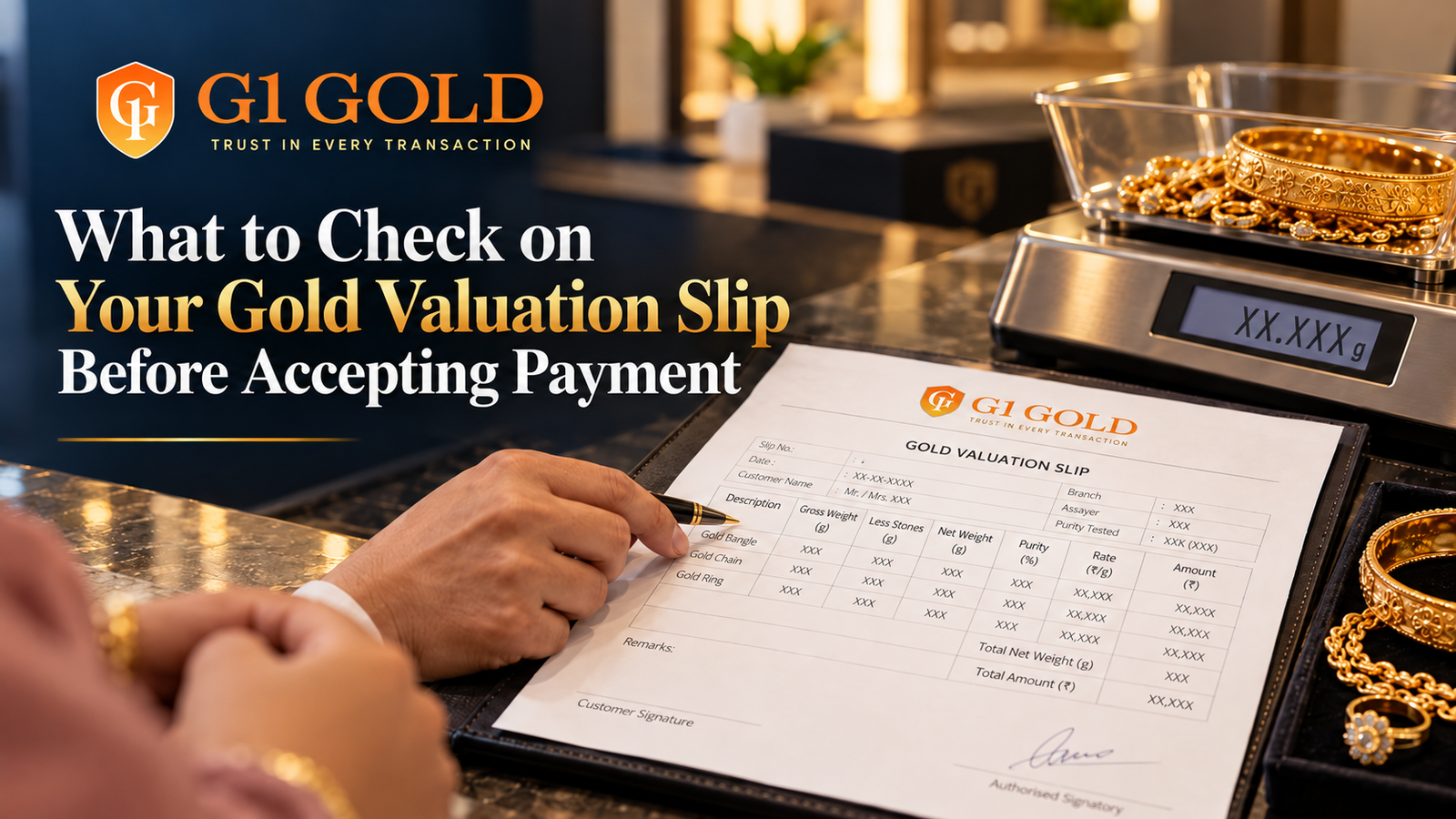
    What to Check on Your Gold Valuation Slip Before Accepting Payment

    When you visit a gold buying branch to sell your old jewellery, the buyer checks its purity and weight before preparing a Gold Valuation Slip. But how can you tell if the amount shown on the slip is calculated correctly?

    A gold valuation slip shows how the buyer determines the value of your jewellery. It helps you understand the gold weight, purity, current rate, and final payment amount.

    Before you sell gold in Bangalore, take a moment to review these details. Knowing what each figure means can help you avoid confusion and make a better decision.

    Here are the key things to check on your gold valuation slip before accepting payment.

    1. Understand the Difference Between Gross Weight and Net Gold Weight

    Net gold weight is an important detail to check on your gold valuation slip.

    Gross weight includes the entire ornament, while net gold-alloy weight excludes stones, beads, and other non-gold materials.

    For example, if your necklace weighs 25 grams but contains 3 grams of stones and other materials, the remaining weight is 22 grams.

    Valuation Detail Weight
    Gross Jewellery Weight 25 grams
    Non-Gold Material Weight 3 grams
    Net Gold-Alloy Weight 22 grams

    In this example, only 22 grams are considered for gold valuation before checking the purity.

    The final gold value also depends on how pure the gold is.

    Before accepting the valuation, ask the buyer:

    • How was the net gold weight calculated?
    • Were stones and other materials excluded?
    • Does the net weight match the amount shown on the slip?

    Checking these details helps you understand how the buyer calculated your jewellery’s value.

    2. Check the Gold Purity Mentioned on the Slip

    Gold jewellery comes in different purity levels. Some ornaments are made from 22-karat gold, while others contain 18-karat or lower-purity gold.

    The purity of your jewellery affects its selling value. Therefore, gold buyers in Bangalore check the gold purity before calculating the final amount.

    Before accepting your gold valuation slip, check these details:

    • Is the tested gold purity clearly mentioned?
    • Were different ornaments tested separately?
    • Does the purity shown on the slip match the test results?
    • Did the buyer explain any difference between the hallmark and tested purity?

    For example:

    • 22K gold: Contains approximately 91.67% pure gold.
    • 18K gold: Contains 75% pure gold.

    Higher gold purity generally means a higher value per gram when other factors are the same.

    Always check the purity results and ask for an explanation if anything is unclear before accepting the final valuation.

    3. Check the Gold Rate Used for Valuation

    Gold rates change daily based on market conditions. So, it is important to check the rate used to calculate your jewellery’s value.

    Your gold valuation slip should clearly show the gold rate applied during the valuation.

    Before accepting the final amount, check these details:

    • What is today’s gold rate?
    • Is the rate based on 24K, 22K, or another gold purity?
    • Does the buyer use the tested gold purity to calculate the value?
    • Is the gold rate per gram clearly mentioned on the slip?

    The market gold rate and the buying rate offered by a gold buyer may be different.

    For example, the displayed market rate may not be the exact rate used to purchase your jewellery.

    Always confirm which gold rate is applied and how it affects your final payment. This helps you understand the offered amount before selling your gold.

    4. Check for Deductions Before Accepting the Final Amount

    The final payment may be different from the calculated gold value if the buyer applies any deductions.

    For example, your jewellery may be valued at ₹85,000, but the buyer offers ₹82,500. Before accepting, ask why ₹2,500 was deducted.

    Check your gold valuation slip for the following details:

    • Are there any gold testing or processing charges?
    • Were deductions made for stones or other non-gold materials?
    • Are there any additional service charges?
    • Has the buyer explained every deduction from the calculated value?

    Not every gold buyer follows the same deduction policy. So, make sure you understand each charge before agreeing to sell your jewellery.

    At G1 Gold Company, customers can ask about gold purity, weight, applied gold rates, and the final payment amount before approving the sale.

    5. Check the Calculated Gold Value and Final Payment

    After checking the gold purity, weight, and gold rate, make sure the final payment matches the calculated value.

    Your gold valuation slip should clearly show how the buyer calculated the amount offered for your jewellery.

    For example:

    Valuation Detail Example
    Net Gold Weight 20 grams
    Gold Purity 22K (91.67%)
    Example 24K Gold Rate ₹12,000 per gram
    Calculated Gold Value ₹2,20,008
    Example Deduction ₹2,000
    Final Payment Amount ₹2,18,008

    Note: These amounts are only examples and do not represent today’s gold rates. The calculation uses a rounded purity of 91.67%.

    Before accepting payment, check these details:

    • Does the calculated value match the gold weight, purity, and rate?
    • Are all deductions clearly mentioned?
    • Does the final amount match the buyer’s offer?
    • Has the buyer explained how the final payment was calculated?

    If the slip shows only the final amount, ask for a detailed breakdown.

    Checking the calculation helps you understand your jewellery’s value before accepting payment.

    6. Keep a Copy of Your Gold Valuation and Payment Records

    After selling your gold, keep a copy of your gold valuation slip and payment receipt.

    These documents help you check the transaction details if needed in the future.

    Make sure your records include:

    • The date you sold your gold.
    • Details of the jewellery you sold.
    • The final agreed payment amount.
    • Payment confirmation or transaction reference number.

    Keep these documents in a safe place for future reference.

    Having a copy of your records helps you confirm what you sold and how much you received.

    Conclusion

    Selling old gold jewellery is easier when you know how its value is calculated.

    A gold valuation slip shows the gold weight, purity, current rate, deductions, and final payment amount. Checking these details helps you understand the price offered for your jewellery.

    Whether you are selling unused jewellery or gold released from a loan, check its value before accepting payment.

    G1 Gold Company checks your jewellery’s purity and weight. The team also explains how the final gold value is calculated.

    Always check the final amount and ask questions if anything is unclear before completing your gold sale.

    Frequently Asked Questions

    1. What is a gold valuation slip?

    A gold valuation slip shows how a buyer calculates your jewellery’s value. It may include gold weight, purity, current gold rate, deductions, and final payment amount.

    2. Why is net gold weight different from gross weight?

    Gross weight includes the entire ornament, including stones and other materials. Net gold-alloy weight excludes these non-gold materials. The buyer then checks the gold purity to calculate its value.

    3. Can I ask the buyer to explain the gold valuation?

    Yes. You can ask the buyer to explain the gold purity, weight, applied gold rate, and any deductions before accepting the final offer.

    4. Does a gold valuation slip confirm the final payment?

    Not always. The final payment may depend on completing the gold verification and approval process. Confirm the agreed amount before handing over your jewellery.

    5. Should I keep my gold valuation slip after selling my jewellery?

    Yes. Keep your gold valuation slip, sales receipt, and payment confirmation. These documents help you check your transaction details whenever needed.


  • A Simple Guide for Bus Conductors Choosing Gold Buyers

    A Simple Guide for Bus Conductors Choosing Gold Buyers

    Bus conductors work long hours, follow fixed routes, handle many passengers, and manage household expenses. When an unexpected cost comes up, there may be little time to arrange money.

    Old or unused gold can become one option in such situations. However, selling gold should not be a quick decision. Before choosing Gold Buyers, it is useful to understand how purity, weight, gold rate, deductions, and payment affect the final value.

    At G1 Gold, the gold-selling process is explained clearly so customers can understand each stage before making a decision.

    Why Might a Bus Conductor Consider Selling Old Gold?

    A conductor may already have most of the monthly income planned for rent, groceries, travel, school fees, or loan payments. A sudden expense can disturb that budget.

    Some situations may include:

    • An unexpected medical bill
    • School or college fees
    • Two-wheeler repair costs
    • House rent
    • Family emergencies
    • Loan or EMI payments
    • Urgent travel
    • Home repair expenses

    If old jewellery is lying unused, selling it may help arrange money without adding another repayment obligation.

    Still, the jewellery should be valued properly before selling.

    How Do Gold Buyers Calculate the Value of Old Gold?

    Gold Buyers usually check the purity, weight, gold rate, and any non-gold materials to find the final value of the jewellery.

    For example, a conductor may bring an old necklace with stones. The necklace may weigh 30 grams, but the full weight may not be gold. Stones, beads, hooks, and other materials can affect the net gold weight.

    Important factors include:

    • Gold purity: Shows how much actual gold is present
    • Net gold weight: Gold weight after excluding non-gold materials
    • Gold rate: The rate considered during valuation
    • Jewellery composition: Stones and other materials can affect weight
    • Testing result: Confirms the purity identified during evaluation

    Ask how the final amount was calculated.

    What Should a Bus Conductor Check Before Choosing Gold Buyers?

    A conductor may have limited time before or after work to visit a gold buyer. A few basic checks can make the process clearer.

    Look for Gold Buyers who offer:

    • Gold testing in your presence
    • Clear and visible weighing
    • An explanation of the purity result
    • A breakdown of the valuation
    • Clear information about deductions
    • Secure payment options
    • Proper transaction records
    • Staff who answer questions clearly

    The process should help you understand why a particular amount is offered.

    Why Does Gold Purity Matter?

    Gold purity tells you how much pure gold is present in the jewellery.

    A 22K ornament and an 18K ornament of the same weight will not usually have the same value because their gold content is different.

    Before selling, ask:

    • What purity was found?
    • How was the jewellery tested?
    • How does the purity affect the final value?

    The explanation should be easy to understand.

    Why Should You Check the Weight Carefully?

    Weight has a direct impact on gold valuation.

    Suppose you bring a chain with a stone pendant. The scale may show the total weight, but the final valuation may use only the actual gold content.

    Ask the buyer to explain:

    • Gross jewellery weight
    • Weight of stones or other materials
    • Net gold weight used for valuation

    Seeing the weighing process can make the transaction easier to understand.

    Should Bus Conductors Compare Gold Buyers?

    Comparing Gold Buyers can help you see differences in gold testing, deductions, payment options, and the final value offered.

    You can compare:

    • Gold purity testing
    • Gold rate used
    • Net weight calculation
    • Deductions
    • Final amount offered
    • Payment method
    • Customer feedback

    An attractive advertised rate alone does not show whether the process is transparent.

    The final decision should be based on the complete valuation.

    Questions to Ask Before Selling Your Gold

    Before agreeing to the sale, ask:

    • What purity did you find?
    • What is the net gold weight?
    • Which gold rate are you using?
    • Are any deductions being made?
    • Why are those deductions applied?
    • What is the final amount I will receive?
    • How will the payment be made?
    • What documents do I need?

    These questions can help prevent confusion.

    Can Broken or Unused Gold Still Be Sold?

    Yes. Gold jewellery can still have value even if it is broken, damaged, or unused.

    Items may include:

    • Broken chains
    • Single earrings
    • Bent rings
    • Damaged bangles
    • Old necklaces
    • Unused jewellery
    • Outdated designs

    The value mainly depends on gold purity and net weight, not the condition of the jewellery.

    Even a broken chain may still have value based on its purity and weight.

    Should You Sell Jewellery With Emotional Value?

    Not every piece of gold is only about money.

    A ring from a parent, wedding jewellery, or a family ornament may have strong emotional value.

    Before selling, think about whether you may want the jewellery again in the future.

    Unused gold with little emotional value may be easier to sell.

    What Documents May Be Needed?

    Gold Buyers may ask for documents before completing the sale.

    You may need to provide:

    • Government-issued ID
    • PAN details, if required
    • Mobile number
    • Address details
    • Bank details for payment

    Ask which documents are needed before visiting. This can save time for bus conductors with busy schedules.

    How Can a Bus Conductor Make a Better Gold Selling Decision?

    After a long shift, a bus conductor may want to finish the gold-selling process quickly. Still, it is important to understand the valuation first.

    Before confirming the sale:

    • Check the jewellery you want to sell
    • Know its approximate purity, if possible
    • Watch the gold testing process
    • Check the weight shown on the scale
    • Ask which gold rate is being used
    • Understand any deductions
    • Confirm the final amount you will receive
    • Check how the payment will be made

    At G1 Gold, the valuation process is explained clearly so customers can understand each step before deciding to sell.

    Conclusion

    Choosing Gold Buyers is not only about finding the nearest shop or checking the advertised gold rate.

    For a bus conductor selling gold for an urgent expense, it is important to understand the process. Purity testing, net weight, deductions, final value, and payment should be explained clearly.

    Taking a few extra minutes to ask questions can help you understand your gold’s value and make a better decision.

    Frequently Asked Questions

    1. What should a bus conductor check before choosing Gold Buyers?

    Check how the buyer tests the gold, measures the weight, calculates the value, explains deductions, and makes the payment. The process should be clear before you sell.

    2. Can broken gold jewellery still be sold?

    Yes. Broken gold jewellery may still have value. The value usually depends on its gold purity and net weight, not its condition.

    3. How is the value of old gold calculated?

    The value is usually based on gold purity, net gold weight, the gold rate used, and deductions for stones or other materials.

    4. Is the original jewellery bill required?

    It depends on the buyer. Some Gold Buyers may accept jewellery without the original bill but may ask for valid ID and other required documents.

    5. Should I compare Gold Buyers before selling?

    Yes. Compare gold testing, valuation, deductions, service, and payment options. This can help you choose a buyer with a clearer process.

  • India Wins 85 Medals at Asian Games 2026: Make Your Own Gold Moment Count

    India Wins 85 Medals at Asian Games 2026: Make Your Own Gold Moment Count

    Winning a medal takes years of hard work and dedication. India at Asian Games 2026 shows the hard work of our athletes. They train every day and prepare to give their best in every competition.

    There may be no cameras, cheering crowds or celebrations during training. However, every small effort brings the athlete closer to success.

    Indian athletes have shown this dedication at the Asian Games 2026, held in Aichi-Nagoya, Japan, from September 19 to October 4.

    As of October 3, India has won 85 medals, including 21 gold, 27 silver and 37 bronze, securing fifth place in the overall medal standings.

    These medals are more than numbers. They represent years of practice, personal sacrifices and determination.

    At G1 Gold, we believe every gram matters, just as every medal tells a story of hard work. As India celebrates its gold medal winners, their achievements also remind us of the importance of understanding the value of the gold we already own.

    India’s Medal Count at the Asian Games 2026

    Indian athletes have delivered memorable performances across individual and team competitions. From archery and shooting to cricket, boxing and golf, different sporting disciplines have contributed to India’s medal collection.

    Here is the reported Indian medal tally as of October 3, 2026:

     Category  Total Medals
    Gold Medals 21
    Silver Medals 27
    Bronze Medals 37
    Total 85

    India’s performance demonstrates the growing range of sporting talent emerging from different parts of the country.

    Every medal represents an individual or collective achievement, while every participating athlete contributes to India’s presence on the international stage.

    How India Dominated the 2026 Asian Games Across Different Sports

    India performed remarkably well at the Asian Games 2026, winning medals across different sports. Explore India’s sport-wise medal tally, top athletes, key achievements and memorable victories.

    1. India’s Gold Medal Winners – Asian Games 2026

    Sport Event Indian Winner(s)
    Cricket Women’s T20 Team India
    Shooting Mixed Team 10m Air Pistol Kamaljeet, Suruchi Singh
    Kabaddi Women’s Team Team India
    Kabaddi Men’s Team Team India
    Shooting Women’s Trap Neeru Dhanda
    Athletics Women’s 4×400m Relay Kiran Pahal, Poovamma MR, Prachi Choudhary, Vithya Ramraj
    Archery Women’s Compound Team Jyothi Surekha Vennam, Prithika Pradeep, Chikitha Taniparthi
    Archery Mixed Compound Team Chikitha Taniparthi, Sahil Jadhav
    Archery Men’s Compound Team Sahil Jadhav, Ganesh Mani Ratnam Thirumuru, Kushal Dalal
    Shooting Mixed Trap Kynan Chenai, Neeru Dhanda
    Archery Women’s Team Recurve Ankita Bhakat, Kumkum Mohod, Kirti Sharma
    Boxing Women’s 75kg Lovlina Borgohain
    Boxing Women’s 65kg Parveen Hooda
    Boxing Men’s 80kg Ankush
    Archery Women’s Individual Recurve Kumkum Mohod
    Golf Women’s Individual Pranavi Urs
    Hockey Women’s Team Team India
    Athletics Women’s 10,000m (Additional entry) Seema Kumari


    2. India’s Silver Medal Winners – Asian Games 2026

    Sport Event Indian Winner(s)
    Shooting Women’s 10m Air Rifle Team Elavenil Valarivan, Sonam Maskar, Vidarsa Vinod
    Shooting Women’s 10m Air Rifle Elavenil Valarivan
    Shooting Men’s 10m Air Rifle Team Rudrankksh Patil, Parth Mane, Himanshu Dhillon
    Shooting Men’s 10m Air Rifle Himanshu Dhillon
    Weightlifting Women’s 49kg Mirabai Chanu
    Wushu Women’s 60kg Sanda Roshibina Devi
    Athletics Mixed 4×400m Relay Team India
    Shooting Men’s 50m Rifle 3P Team Aishwary Pratap Singh Tomar, Rudrankksh Patil, Niraj Kumar
    Athletics Men’s 10,000m Gulveer Singh
    Athletics Men’s Marathon Sawan Berwal
    Golf Women’s Team Pranavi Urs, Aditi Ashok, Diksha Dagar
    Rowing Men’s Double Sculls Satnam Singh, Salman Khan


    3. India’s Bronze Medal Winners – Asian Games 2026

    Sport Event Indian Winner(s)
    Shooting Men’s 10m Air Rifle Rudrankksh Patil
    MMA Women’s Traditional 60kg Suchika Tariyal
    Shooting Women’s Skeet Team Parinaaz Dhaliwal, Raiza Dhillon, Maheshwari Chauhan
    Shooting Mixed Skeet Team Parinaaz Dhaliwal, Anantjeet Singh Naruka
    Soft Tennis Men’s Singles Jay Meena
    Badminton Men’s Team Team India
    Rowing Men’s Double Sculls Satnam Singh, Salman Khan
    Athletics Women’s 10,000m Seema Kumari
    Squash Mixed Doubles Joshna Chinappa, Velavan

    Every victory adds to India’s sporting achievements and shows the hard work and dedication of our athletes.


    Women’s Cricket Team Wins Gold for India

    India’s women’s cricket team won gold after defeating Sri Lanka by 147 runs in the final. They bowled Sri Lanka out for just 69 runs.

    The victory highlighted the team’s excellent performance, hard work and teamwork.

    India also won gold in men’s cricket after defeating Pakistan by 19 runs in the October 3 final.


    Kumkum Mohod Wins Gold in Archery

    Kumkum Mohod won gold for India in women’s recurve archery by defeating South Korea’s Oh Yejin in a close shoot-off.

    Her victory showed her focus, confidence and excellent archery skills.

    Indian archers also won gold medals in compound and team events, adding to India’s success at the Asian Games 2026.


    Lovlina Borgohain Wins Gold in Boxing

    Olympic bronze medallist Lovlina Borgohain won gold for India in the women’s 75kg boxing event.

    Her victory reflected her hard work, experience and dedication.

    Other Indian boxers also performed well, winning more gold medals for India at the Asian Games 2026.


    Pranavi Urs Wins Gold in Golf

    Pranavi Urs won gold for India in the women’s individual golf event, finishing at 15-under par after four rounds.

    Her victory was a proud achievement for Indian golf and highlighted the talent of Indian athletes in different sports.


    India’s Women’s Hockey Team Wins Gold After 44 Years

    India’s women’s hockey team defeated China to win gold, ending a 44-year wait for an Asian Games gold medal.

    The victory was a proud moment for the players, coaches and supporters. It reflected their hard work, teamwork and dedication.

    This achievement shows that success comes with patience, determination and years of effort.


    Every Silver and Bronze Medal Matters

    Gold medals often get more attention, but India’s 26 silver and 36 bronze medals are equally important.

    Mirabai Chanu won silver in women’s 49kg weightlifting, while Gulveer Singh secured silver in the men’s 10,000m event.

    Indian athletes also won medals in shooting, rowing, athletics, badminton and other sports.

    Every silver and bronze medal represents years of hard work and dedication. For many athletes, winning a medal is a dream come true.

    These achievements remind us that every medal matters, regardless of its colour.


    What India’s Success Teaches Us About Gold’s Value

    India’s athletes worked for years to achieve their dreams. Similarly, the gold jewellery we keep at home can hold both emotional and financial value.

    An old necklace, unused earrings or a family bracelet may be worth more than expected.

    Understanding your gold’s purity, weight and current market value can help you make better financial decisions.

    Just as athletes prepare before a competition, knowing your gold’s value is important before deciding to sell.


    Your Gold, Your Decision: Understand Its True Value with G1 Gold

    India’s sporting achievements remind us that every effort matters. At G1 Gold, we believe every gram of gold deserves an accurate valuation.

    Whether you plan to Sell Gold in Bangalore or are searching for Gold Buyers in Bangalore, we offer live purity testing, accurate weighing and transparent calculations based on the current market rate.

    Once you accept the final offer, payment is processed securely without hidden charges.


    G1 Gold proudly congratulates Team India and every athlete who made the nation proud at the Asian Games 2026.

    As India celebrates its achievements at the Asian Games 2026, G1 Gold extends its congratulations to every athlete, coach and support team who contributed to these memorable performances.


    Every medal represents an achievement. Every gram deserves an accurate value.

    G1 Gold – Every Gram Matters.

    Website: https://www.g1gold.com/
    Location: Malleshwaram, Bengaluru


  • Sell Gold for Vehicle Repair Expenses: A Guide for Drivers

    Sell Gold for Vehicle Repair Expenses: A Guide for Drivers

    For a driver, a vehicle breakdown is not just a repair issue. It can immediately affect daily income, which is why some drivers may choose to sell gold to cover vehicle repair expenses.

    A cab driver, delivery rider, transport operator, or field worker may lose earning opportunities every day the vehicle stays off the road. That is why the real question is not only, “How much will the repair cost?”

    A better question is:

    How much is this breakdown costing me each day, and what is the fastest practical way to return the vehicle to work?

    If you own unused gold jewellery, selling part of it can sometimes help manage urgent vehicle repair expenses. Before doing that, G1 Gold recommends understanding both the actual repair need and the real value of the gold you plan to sell.

    Calculate the Cost of Downtime

    Many drivers look only at the mechanic’s repair estimate.

    But the real financial impact may include:

    • Lost daily income
    • Alternative transport costs
    • Towing or parking charges
    • Loan or EMI payments continuing during downtime
    • Extra damage caused by delaying the repair

    For income-dependent drivers, downtime itself can become a major cost.

    Before selling gold, ask:

    Will repairing the vehicle now help restore my income quickly?

    If yes, the repair may be more economically important than it first appears.

    Separate Urgent Repairs From Optional Repairs

    Ask the mechanic to divide the repair estimate into categories.

    Safety-Critical Repairs

    These may include:

    • Brake problems
    • Steering issues
    • Tyre damage
    • Suspension failure
    • Serious electrical faults
    • Overheating problems

    Vehicle-Immobilising Repairs

    These are faults that prevent the vehicle from returning to work, such as:

    • Clutch failure
    • Starter motor issues
    • Gearbox problems
    • Battery or charging system failure
    • Fuel system faults
    • Serious engine problems

    Non-Urgent Repairs

    Cosmetic work, minor dents, interior repairs, or non-essential accessories may sometimes be postponed.

    This approach can help you identify the amount needed to make the vehicle safe and usable again, instead of paying for every repair at once.

    Understand Your Gold’s Value Before You Sell Gold for Vehicle Repair

    A common mistake is assuming:

    Gold weight × today’s gold rate = final amount received.

    Jewellery valuation is usually more detailed.

    A simple way to understand it is:

    Net Gold Weight × Purity × Applicable Gold Rate − Relevant Deductions

    Gross Weight vs Net Weight

    Gross weight is the total weight of the ornament.

    It may include:

    • Stones
    • Beads
    • Hooks
    • Enamel
    • Thread
    • Other non-gold materials

    Net gold weight is the actual gold content considered for valuation.

    This difference can have a significant impact on the final value.

    Ask for the Actual Purity Reading

    Do not rely only on a verbal statement such as “This is 22K.”

    Ask for the tested purity or fineness result.

    Useful questions include:

    • What purity did the test show?
    • Was more than one point tested?
    • Can I see the test result?
    • Is the valuation based on the actual purity reading?

    At G1 Gold, customers can understand the testing and valuation process before making a decision.

    Check the Gold Rate Before You Sell Gold for Vehicle Repair

    Another important point is the rate applied during valuation.

    A displayed 24K rate should not automatically be treated as the payable rate for lower-purity jewellery.

    Ask:

    • Which rate is being applied?
    • Is it based on 24K, 22K, or the tested purity?
    • How is purity adjusted in the calculation?
    • Are there any deductions after that?

    This helps you understand how the final offer is calculated.

    Sell Only What You Need

    When a repair is urgent, there is a temptation to sell an entire piece of jewellery even when only part of its value is needed.

    If you own multiple unused ornaments, evaluate them separately.

    You may find that:

    • One ring is enough
    • A broken chain can cover the requirement
    • A smaller ornament is sufficient
    • Sentimental jewellery does not need to be sold

    Matching the gold value to the repair requirement can help you avoid selling more than necessary.

    Compare the Repair With the Vehicle’s Value

    Before using gold to fund a major repair, consider the vehicle’s overall condition.

    Check:

    • Vehicle age
    • Current resale value
    • Frequency of recent repairs
    • Expected maintenance
    • Fuel efficiency
    • Reliability after repair
    • Remaining useful life

    If the vehicle is repeatedly breaking down, another major repair may not always make financial sense.

    But if the vehicle is otherwise reliable and the repair restores regular use, the decision may be more practical.

    Ask How Long the Repair Is Expected to Last

    Instead of asking only, “Can this be fixed?” ask:

    How long should this repair last?

    Also check:

    • Whether the part is new or refurbished
    • Whether there is a warranty
    • Whether labour is covered
    • Whether another connected component may fail soon

    This helps you understand whether the repair provides lasting value or only a temporary solution.

    When It May Make Sense to Sell Gold for Vehicle Repair

    Selling unused gold may be worth considering when:

    • The vehicle directly supports your income
    • The repair is necessary to resume work
    • The vehicle remains useful after repair
    • The repair cost is clearly understood
    • The gold is genuinely unused
    • The valuation process is transparent
    • You are selling only what is necessary

    If you decide to proceed, a transparent gold buyer such as G1 Gold can help you understand purity, net weight, applicable rate, and the final valuation before completing the transaction.

    Conclusion

    For drivers, a breakdown can create two problems at once: repair expenses and lost income.

    That is why the decision should go beyond simply checking how much the mechanic charges.

    Calculate downtime, identify essential repairs, understand the vehicle’s future usefulness, and verify the real value of your gold before selling.

    The goal should not simply be to get quick cash.

    It should be to use an existing asset carefully to restore an income-producing vehicle.

    Frequently Asked Questions

    1. How much gold should I sell for vehicle repairs?

    Start with the confirmed repair requirement and choose the smallest suitable gold item that can meet that need.

    2. Why can gold value differ from total jewellery weight?

    Jewellery may contain stones, beads, hooks, or other non-gold materials. The valuation mainly depends on net gold weight and tested purity.

    3. Should I Sell Gold for Vehicle Repair on an Old Vehicle?

    Compare the repair cost with the vehicle’s resale value, expected life after repair, recent breakdown history, and future maintenance needs.

    4. What should I ask during a gold purity test?

    Ask for the actual purity result, the testing method, and how the result affects the payable value.

    5. Why Does Downtime Matter When You Sell Gold for Vehicle Repair?

    If the vehicle supports your income, every day it remains unused may mean lost earning opportunities. That makes downtime an important part of the repair decision.